Ever turn a West Village corner and feel like the neighborhood is keeping a secret? That feeling is part of the area’s lasting appeal. If you are drawn to places with texture, history, and a quieter kind of charm, these hidden courtyards and lanes help explain why the West Village feels so distinct. Let’s take a closer look at where these tucked-away spaces came from, what makes them special, and why they still matter today.
Why West Village Hidden Courtyards Exist
The West Village did not grow from Manhattan’s strict street grid in the same way many other neighborhoods did. Its streets follow older colonial-era paths and irregular angles, which created unusual parcels, rear yards, and service lanes over time.
Those leftover spaces became some of the neighborhood’s most memorable small enclaves. What might have started as stables, service courts, or cottages behind street-front homes now reads as a series of intimate pockets that feel separate from the city around them.
Preservation has also played a major role in what you see today. The adjacent Greenwich Village Historic District, designated in 1969 and covering roughly 2,200 buildings across more than 100 blocks, has helped preserve a low-rise, cohesive streetscape through the city’s landmarks review framework.
What Hidden Spaces Look Like
Mews and Stable Lanes
In New York, a mews usually points to a former stable lane tied to nearby townhouses. These spaces often still show their origins through gates, cobbled surfaces, and low-rise building forms that once supported carriage life.
Today, many mews remain private or semi-private. That limited access adds to their appeal and helps preserve the sense that you have found something tucked just out of view.
Residential Courts
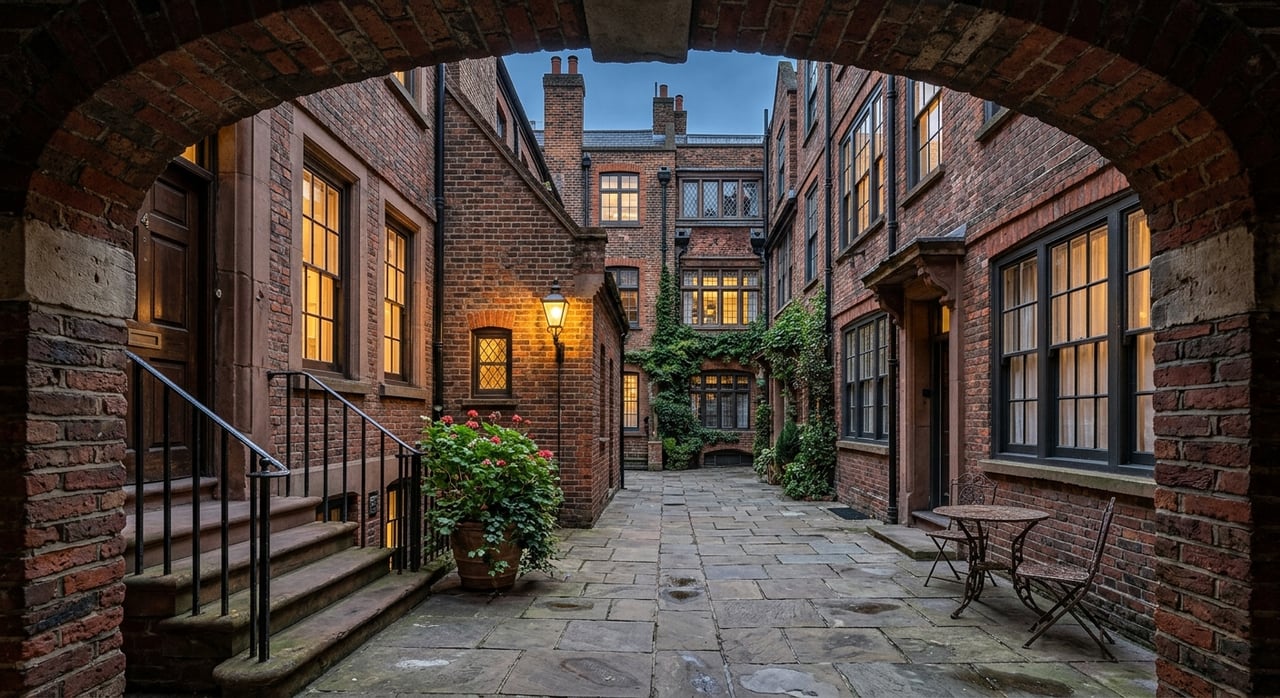
Courts are smaller residential pockets set behind or between street-facing buildings. They can feel almost like interior rooms of the neighborhood, especially when they are gated or shaped by unusual lot lines.
Unlike a typical block, a court often feels enclosed and calm. That sense of separation is a big part of why these places leave such a strong impression.
Garden-Centered Rows
Some of the Village’s hidden spaces are organized around shared open space rather than lanes or passages. In these cases, houses are arranged around an interior garden, creating a clear courtyard setting within dense historic fabric.
This layout offers a useful example of how open space can exist within a compact urban setting. It also shows how design can make city living feel more private and grounded.
Hidden Courtyards to Know
Washington Mews
Just north of Washington Square Park, Washington Mews is one of the area’s best-known hidden lanes. Historic district documentation describes it as a private street with low two-story buildings, a cobbled surface, and a gate at the west end.
Its origins are tied to stable buildings that once served nearby homes on Washington Square North. What stands out today is the feeling of light, air, and separation from traffic, which gives the block an urban village quality that is hard to forget.
MacDougal Alley
MacDougal Alley was formally created in 1833 as a private court for stables serving nearby townhouses. Over time, many of those former stable buildings were converted into dwellings and studios.
The result is a setting known for its small scale, varied rooflines, and picturesque character. It also offers a strong visual contrast between historic building fabric and larger later construction nearby.
Grove Court
Grove Court is one of the clearest examples of a hidden residential pocket in the Village. It sits behind 10 and 12 Grove Street, where a bend in the street created space for a private gate and triangular courtyard.
Built in 1852 to 1854 as workingmen’s cottages on the rear yards of earlier houses, it was renovated in the 1920s and later marketed to artists. That layered history helps explain why it feels both intimate and storied.
Patchin Place and Milligan Place
Patchin Place and Milligan Place are narrow cul-de-sacs off West 10th Street. Both began as modest workers’ cottages in the mid-19th century, and both still feel strikingly small in scale compared with the surrounding city.
Their details make them especially memorable on foot. Patchin Place is known for its gas lamp, while Milligan Place is marked by a wrought-iron gate that reinforces the feeling of stepping into a more enclosed setting.
MacDougal-Sullivan Gardens
If you want the clearest courtyard-style plan in the area, MacDougal-Sullivan Gardens stands out. In the 1920s, the site was redesigned to preserve two rows of houses while creating a common interior garden.
Each house retained a small private garden while sharing the larger central open space. The Landmarks Preservation Commission described this communal-garden idea as revolutionary for its time and an early model for later New York garden communities.
Why These Spaces Feel So Different
Across these hidden courtyards and lanes, the same qualities tend to appear again and again. You notice privacy, low traffic, human scale, planted or shared open space, and a clear sense of being set apart without leaving Manhattan.
That combination shapes how the neighborhood feels on a daily basis. Even when you are only a few steps from busier streets, these enclaves create quieter arrivals, less visual clutter, and a stronger sense of place.
For many buyers, that atmosphere is not a small detail. In the West Village, value is often tied not just to square footage or finishes, but to the lived experience of the block, the approach to the home, and the identity of the address itself.
What Hidden Courtyards Mean for Buyers
If you are buying in the West Village, these spaces can help you read the neighborhood more carefully. A tucked-away court, former mews, or garden-centered row often signals a very specific kind of residential experience.
That experience may include a quieter setting, a stronger architectural identity, and a sense of enclosure that feels rare in Manhattan. It can also mean that the surrounding streetscape has retained a lower-rise, more cohesive character because of preservation patterns in the area.
For buyers who care about character, these details can shape long-term satisfaction as much as the apartment itself. They help explain why two homes only blocks apart can feel very different in mood and daily rhythm.
What Hidden Courtyards Mean for Sellers
If you own near one of these tucked-away spaces, the setting may be part of your home’s story. Buyers often respond strongly to features that create a memorable sense of arrival and a distinctive neighborhood feel.
That does not mean every hidden lane or court carries the same market impact. It does mean that thoughtful positioning, strong visuals, and clear neighborhood context can help buyers understand why a location feels special.
For sellers in historic Manhattan neighborhoods, the most effective marketing often goes beyond a list of finishes. It connects architecture, block character, and daily lifestyle in a way that feels grounded and authentic.
Why Local Context Matters
The West Village is full of details that are easy to miss if you only look at listings online. Hidden courtyards, private lanes, and interior garden spaces are part of what gives the neighborhood its texture, and understanding them takes local knowledge.
That is especially true in Manhattan, where small differences in siting, block pattern, and historic context can shape buyer perception in a meaningful way. When you understand those nuances, you can make more informed decisions whether you are buying, selling, or simply getting to know the market better.
If you are considering a move in Manhattan and want guidance that blends neighborhood expertise with a refined, concierge approach, The Schier Cloonan Team is here to help.
FAQs
What are hidden courtyards in the West Village?
- Hidden courtyards in the West Village are small enclosed residential spaces, lanes, or garden-centered pockets that often grew out of former stables, rear-yard cottages, or service courts behind rowhouses.
Why does the West Village have so many irregular lanes and courts?
- The West Village developed along older colonial-era street patterns rather than the regular 1811 Manhattan grid, which left unusual parcels and rear spaces that later became mews, courts, and enclosed residential lanes.
Which West Village hidden courtyards are most notable?
- Well-known examples include Washington Mews, MacDougal Alley, Grove Court, Patchin Place, Milligan Place, and MacDougal-Sullivan Gardens.
Are West Village hidden courtyards public?
- Some can be viewed from gates or entrances, but many are private or semi-private spaces, so access varies by location.
Why do hidden courtyards matter in West Village real estate?
- These spaces can add privacy, lower traffic exposure, stronger architectural character, and a more distinctive sense of address, all of which can shape how a home feels and how buyers respond to it.
What makes MacDougal-Sullivan Gardens different from a mews or alley?
- MacDougal-Sullivan Gardens is organized around a shared interior garden, making it a clearer courtyard-style plan rather than a former stable lane or narrow service alley.